Diminutives - curatorial text
Curator: Veronika Marek Markovičová
You can explore a photo report from the exhibition here.
Men art teachers at art academies often mock young female artists, asking why they study art at all if they will end up standing behind the stove anyway (a reference also made by the exhibition poster). Yes, many women decide not to have children or to marry well, so they can carefree spend their eight-hour day in the studio and buy something nice for the opening with the little money earned from art. I am cynically simplifying. After all, Daniela Krajčová does not fit this basic typology. She is closer to an “instastory” by Jana Kapelová from the exhibition Liberated Space: Care – Architecture – Feminism, curated by Petra Hlaváčková (Bratislava City Gallery, 09/2023 – 02/2024), which recently stuck in my mind. It featured a photographed text from a project by Barbora Šimonová and Michaela Janečková (Emancipated Woman – Heart of the Home and Lover of the Superlux Class) published in the socialist magazine Domov, stating that women artists are, besides their creative profession, also wives, mothers, cooks, cleaners, etc., and that trying to avoid these roles would be a cowardly escape.
Daniela Krajčová has been on maternity “leave” for eight years now, yet alongside standing at the stove she has managed to win the Oskár Čepan Award (2020), publish the colouring book Trips for Lazy Children for Nota Bene (Katarína Marinová, 2023), create the drawing series Preliesochy (2023) dedicated to public space and sculptures in her hometown Žilina for Nina A. Šoškova’s Contemporary Souvenir project, participate in numerous solo and group exhibitions at home and abroad, and more.
She processes her current life experience not only on a subjective level. What makes her particularly interesting is that her projects often carry participatory and collaborative elements alongside their sociological dimension—such as the recent project Obrúsok / Серветка / Servetka (2022), realized shortly after the outbreak of war in a neighbouring country together with Ukrainian artist Anna Dudik.
When I recall a note from scientific sources shared by my friend Vierka Marčeková, the stress experienced by a mother on maternity leave equals that of a fighter jet pilot. Exactly. Motherhood changes not only our bodies, but also our sleep and our entire lives. Suddenly, we become a nonstop service point, the centre of the family universe, where everything must be lovingly prepared at any time for demands of all kinds. After all, we are not going to work—we are on “holiday,” and even for three years per child, something our Western neighbours mostly cannot afford. Alongside this, Montessori playrooms, forest kindergartens, piles of literature on child-rearing and nutrition, outrageously expensive prams and designer clothing come crashing down on us.
Beyond the modest parental allowance budget, another fact is often not mentioned—I came across it in a text by Czech sociologist Lucie Jarkovská in Dita Pepe’s book The Limits of Love (wo-men, UTB, 2021): according to French historian Élisabeth Badinter, the image of the self-sacrificing mother was constructed only during the Industrial Revolution, when men worked outside the home and women were left locked in apartments alone with children, without prospects for self-realization. Before that, the author claims, the role of mother was just one of many roles women held.
Yes, we live somewhere between female solidarity—such as that portrayed in the remarkable documentary Smoke Sauna Sisterhood by director Anna Hints (Estonia, France, Iceland, 2023), which had its Slovak premiere just a few days ago—and indifference, for example when drivers usually do not stop for you at a pedestrian crossing when you are pushing a stroller, paradoxically not even female drivers. We Slovak women, after all, do not rest on progressive laurels—we raise our children in a country whose patron saint is Our Lady of Sorrows, so the cult of self-sacrifice and suffering is considered perfectly acceptable.
Not entirely, though, because due to male animal insecurity and jealousy it can escalate into domestic violence, to selected cases of which Daniela Krajčová devoted attention within this exhibition project in collaboration with the civic association Náruč in Žilina.
But let us return to the author of this exhibition. Daniela Krajčová captivates with her tenacious work ethic, organization, perseverance, and sensitivity to the suffering and needs of others, including Roma people and migrants. One need only recall her projects Karavan (with Oto Hudec, 2013) and Far Taction (2018), as well as the wide range of media she works with—drawing, printmaking, painting, embroidery, animation, video.
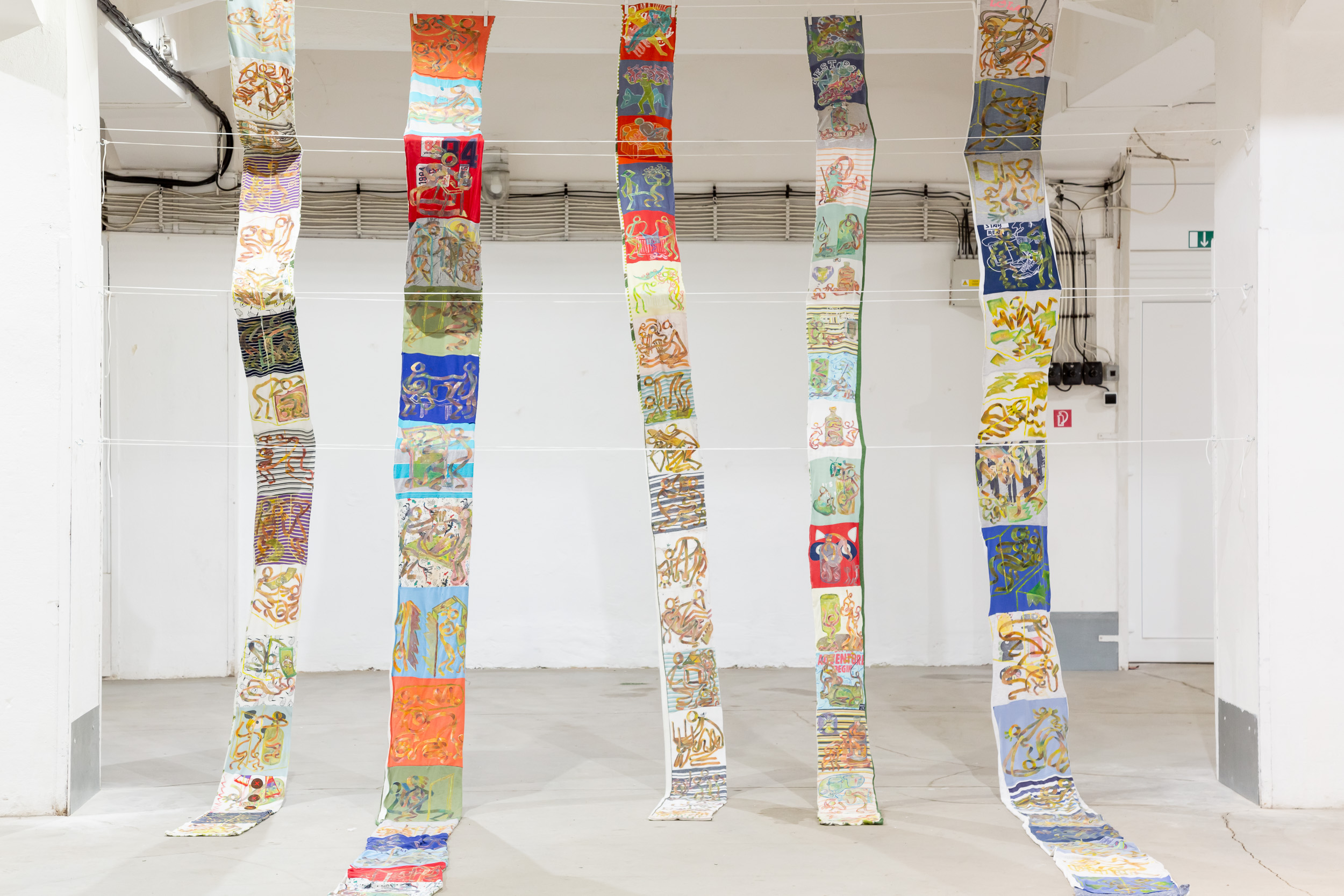
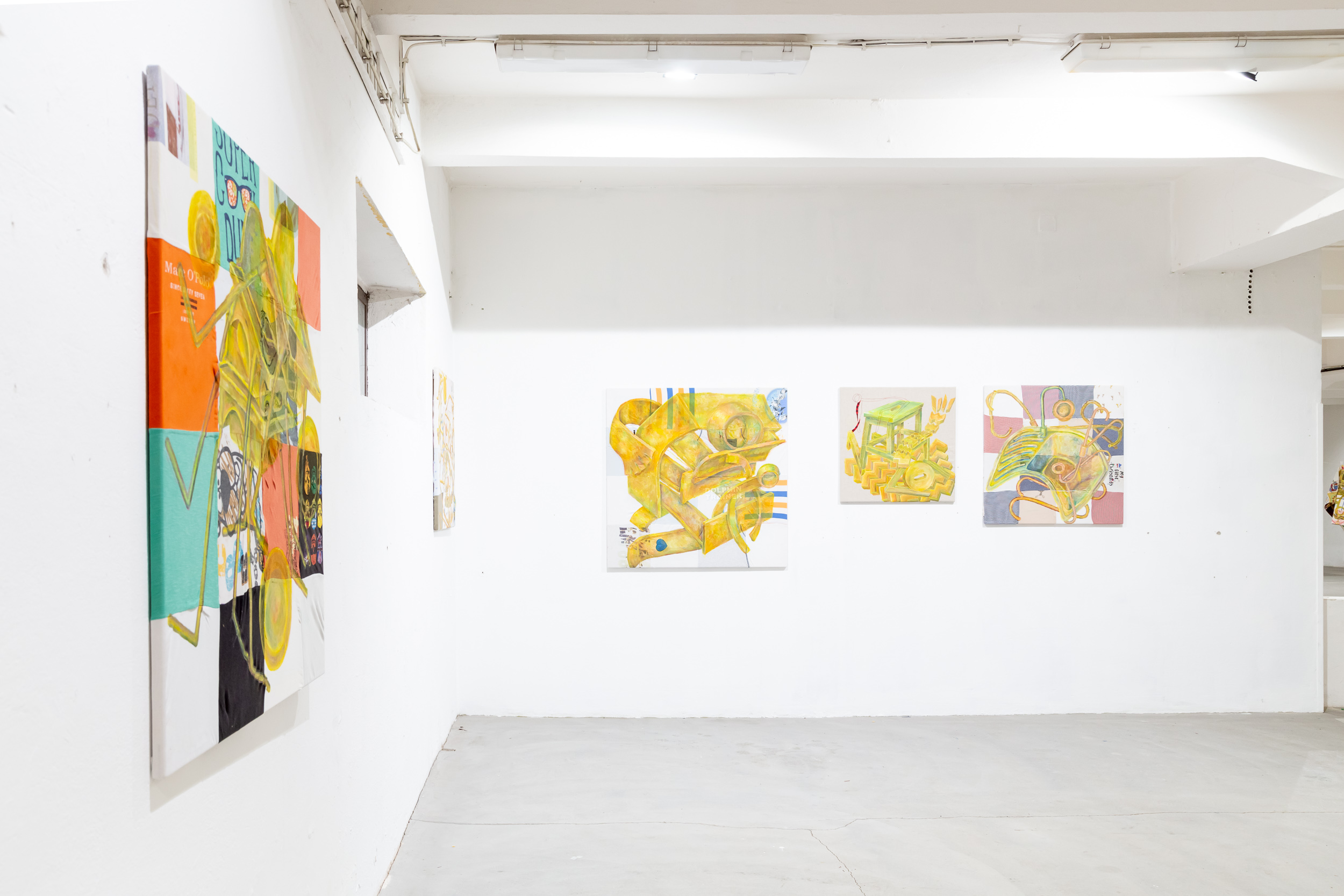
The material that passes through her hands daily in the unstoppable routine of household work is transformed into the substrate of her artworks; she transcends the utility of consumer materials into visual messages—a celebration of women who, when motivated and given perspective, are unstoppable. After a period of schematic geometric drawing—redrawing the content of conversations among mothers about their own, their children’s, partners’, and family crisis situations during maternity leave on social networks—she gradually turned to more time-consuming and meditative painting. Here, objects from the family household are transformed into symbols in which patience, love, exhaustion, and the crossing of personal limits intertwine.
She creates new forms of objects, just as we emerge renewed after each day in which we have managed a moment that once seemed beyond our strength. Her work underscores the will to process through herself all the pleasant and unpleasant moments of family life, when in partnerships into which children have entered, collisions of unfulfilled expectations suddenly surface. Alongside caring for small children, these escalate into unpredictably stressful situations, triggering our own memories and automatic mechanisms, as well as fears about the family’s economic security.
With uncompromising honesty and, at the same time, tenderness, she points to the dysfunction of violence—both physical and psychological—which suddenly overwhelms everyone and everything in the apartment like an unstoppable avalanche, after which restoring the “original state” becomes an extremely fragile and demanding process. By depicting chaos and disorder, Krajčová restores an inner order within herself and a vision of organizing the world around her.
This moment is also referenced by the artist’s “family ornament”—a belief that the family does and will hold together. She symmetrically placed it as a pattern on a tablecloth, at the table where we sit together every day, no matter what kind of day it is. She renders this sine wave of life with children through a metaphorical play of material and form—through clothes and tablecloths soaked with our emotions and memories—stories. But those, each family must tell for themselves.