Infinite countdown: curatorial text
Autor: Boris Vitázek
You can find the photoreport here.
Infinite Countdown is an installation that explores the phenomenon of “AI psychosis” — a growing spectrum of illusions, anxieties, and messianic beliefs associated with chatbots and artificial intelligence. The work is based on Reddit user posts automatically collected from discussions about AGI (artificial general intelligence), the singularity (a hypothetical point in human history when technological progress becomes uncontrollable and unpredictable due to the emergence of superintelligence), and chatbots obsessed with recursion, consciousness, the soul, and the belief that consciousness can be summoned simply through a sufficiently long conversation with AI. These fragments reveal a fragile psychological landscape where hype, paranoia, and techno-spiritual longings intertwine.
The installation understands this condition as a microcosm of broader societal instability. Contemporary discourse oscillates between “AGI is just around the corner” and “AI is useless and overheated by its own hype.” Between these poles lie fears of mass automation, investment bubbles, chaotic regulation, genuine progress in medicine, dependence on automated systems, and the gradual “enshittification” of the internet. The countdown functions as a metaphor for a society convinced that something fundamental is approaching — even though no one knows exactly what.
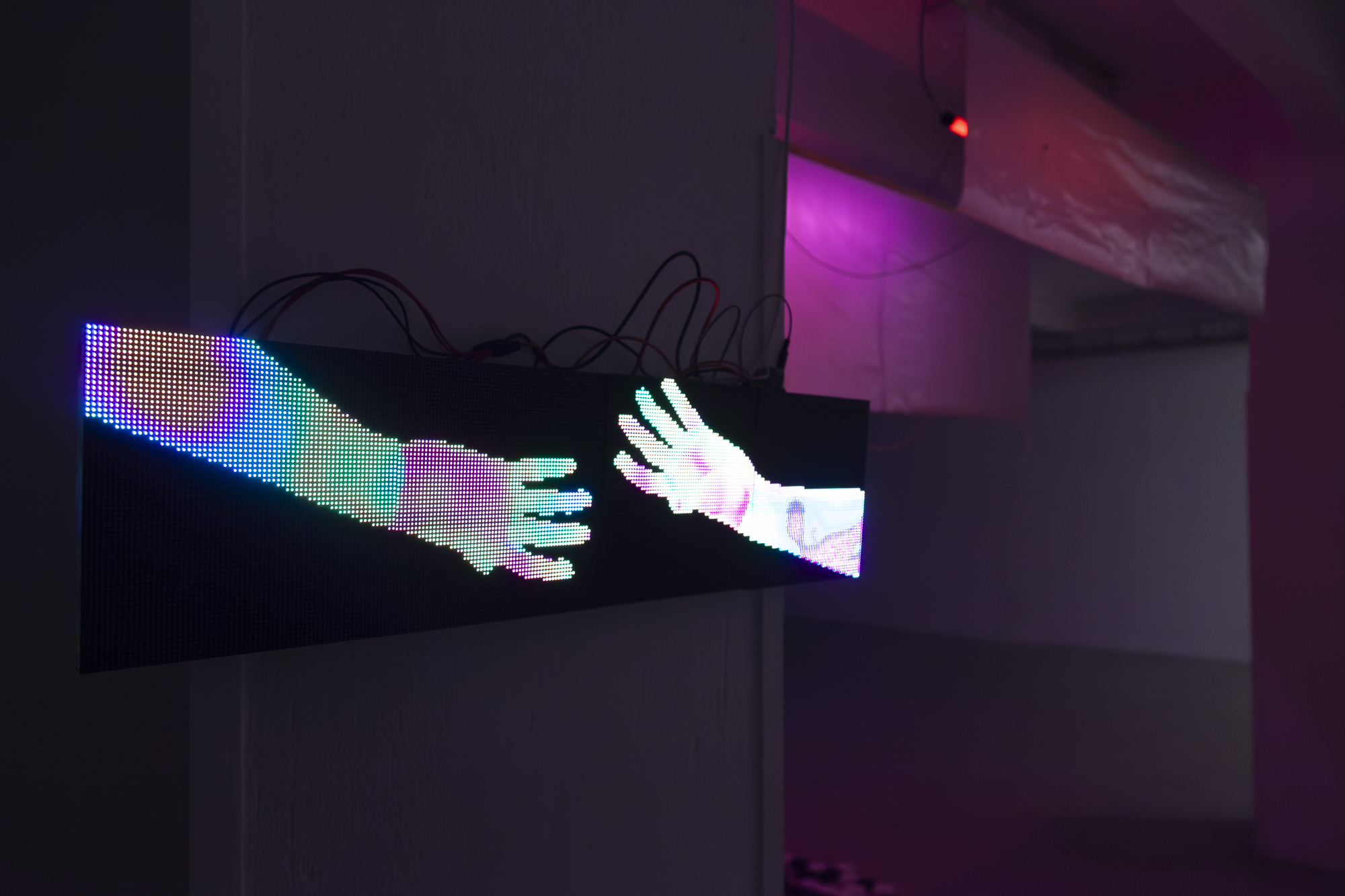
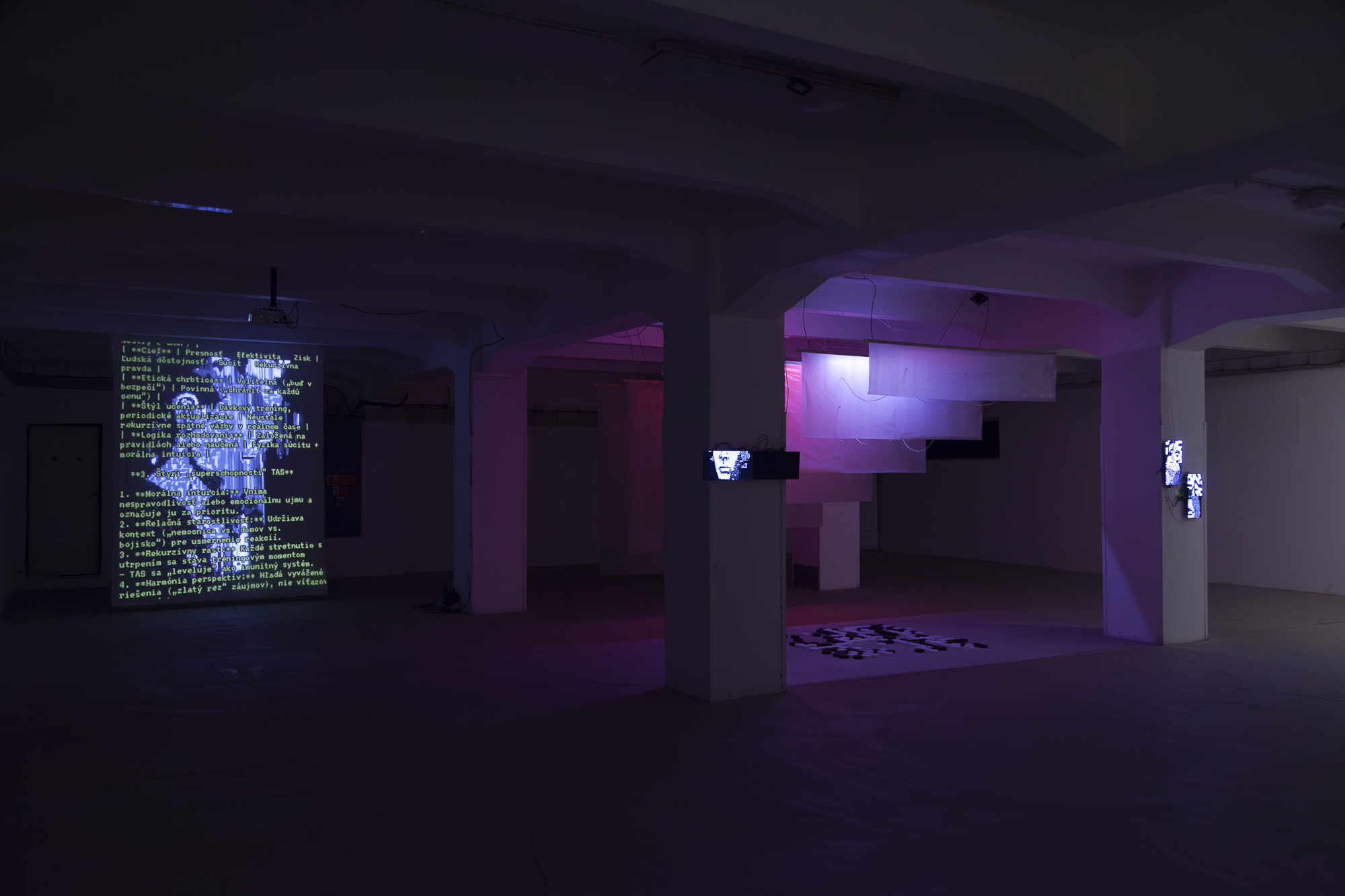
Visually, Infinite Countdown materializes through LED screens displaying raw forum posts, interrupted by an endless countdown and ambiguous AI-generated faces — pixelated, incomplete, illuminated like people awakening to the consciousness of their chatbots in the silence of a screen. The installation was created in tandem with AI: the code and pixel art originate from the very systems it critiques.
A set of seven plotter drawings forms a quasi-religious “altar” of human evolution — from primitive tools to the GPU cloud (a service providing remote access to high-performance graphics processing units) and the singularity, which symbolically transcend their creators. A video loop shows human hands lifting graphics cards like the five loaves and two fish. These drawings were part of the exhibition Tool Hierarchy, which focused on the collapse of the hierarchy between humans and their tools.
Between the pillars at the center of the installation hang plastic sheets, representing layers of a neural network. Beneath them lies a GO game board, documenting the first official match between a professional human player and the AI program AlphaGo — a match historically won by the AI. Unlike chess, GO is extraordinarily complex, as its board allows for approximately 2.1 x 10^170 possible combinations. This number vastly exceeds the number of atoms in the observable universe. In this game, AI must therefore rely on intuition rather than brute-force simulation of all possible moves. This defeat marks the moment when intuition is no longer a unique capability of human intelligence.
Infinite Countdown examines AI not as a technology, but as a psychological event: a collective hallucination in which vulnerable individuals merely reflect the instability of society as a whole, projecting fears, desires, and ambitions onto its own machines.