Re:play - curatorial text
Curator: Mariana Brinzová
You can explore a photo report from the exhibition here.
The artistic duo Dudas Brothers, formed by brothers Ivan Dudáš (1980) and Juraj Dudáš (1975), has been present on the art scene for more than twenty years. Both artists work independently as well as under a shared group identity. Their collaborative works are based on dialogue through which they reflect on current socio-political developments. Their global and regional reflections—expressed through intermedia and multimedia approaches with post-conceptual references—were particularly prominent in the 2000s, which marked their most active period. Among their most resonant works are the Covers series in the form of lightboxes, exhibited in various galleries of major metropolitan cities, as well as the well-known installation Souvenir from Iraq, a number of performative interventions, and their reflection on the Ukrainian issue presented at the Synagogue – Centre for Contemporary Art in Trnava as early as 2014. Many of their works appear timeless in retrospect. Although created several years ago, they can still be read within a contemporary context that resonates strongly with current events. This applies, for example, to themes rooted in social and military conflicts—such as the ongoing conflict in Ukraine, which the artists addressed already at the outset of the unrest in 2014.
In the exhibition RE:PLAY, Dudas Brothers present works created over approximately the last four years. These are complemented by one earlier joint intervention as well as by the most recent works produced specifically for the exhibition, addressing the current political situation in Slovakia. RE:PLAY consists of individual works by both artists alongside a collaboratively created work and a performance.
What is characteristic of the work of Dudas Brothers is their spontaneous responsiveness to shifts in the socio-social and political climate. They react both to global issues and to local, region-specific questions. Current themes include the rise of a new government, the attitudes and statements of the new Minister of Culture, as well as the issue of disinformation and hoaxes. Although this topic has resonated for several years, its impact continues to intensify. Dudas Brothers also cyclically address military conflicts and the issues of migration and refugees. Certain approaches and problems thus recur, while others emerge anew or are updated—continuously replayed and set in motion again (replay). The title RE:PLAY therefore refers to this repetition and the failure to learn from history, while also alluding to playfulness and irony, which are characteristic of the work of Dudas Brothers.
The series of objects titled Is This the End of Conceptual Art or a New Beginning? by Juraj Dudáš searches for answers to what is happening to art based on conceptual principles. The destroyed glasses refer to conceptual art and “ask” whether it has come to an end or whether it continues in the form of post-conceptual or even more contemporary tendencies. Two of the glasses are static and one is kinetic, capturing a gradual process of destruction and deconstruction. The objects respond to Július Koller’s intervention Glass of Pure Water (1963), in which he employed the ready-made of an ordinary glass.
Universe (2019) is another work by Juraj Dudáš. It is an interactive installation in the form of a robotic mirror that responds to the movement of viewers. The mirrored wall creates an image within an image and can be understood as a metaphorical mirror held up to society. The starting point for the work were two mountain villages in Italy and Norway that are illuminated for part of the year by reflections from enormous mirrors; otherwise, due to the shadow of the surrounding mountain massifs, sunlight would not reach them. Juraj Dudáš perceives the work as a visual symbol in which mirrors bring light into darkness, problems, or conflict.
“At the same time, it is a symbol for me of searching for solutions, of providing solar energy and light. Light as an intangible substance that also brings warmth and a sense of safety. Yet what evokes feelings of safety in us can very quickly turn into a feeling of threat. A different angle is enough and light turns into smoke, fire, scorched ground, and then into cold and emptiness. Just as we believe in democracy as a pleasant warmth for our Western civilization, the acute loss of tolerance toward other civilizations and the inability to accept otherness ignites a fire within us. Is this situation merely a flaw in the democratic system? Or are our countries governed by careless people who failed to recognize the danger in time?”
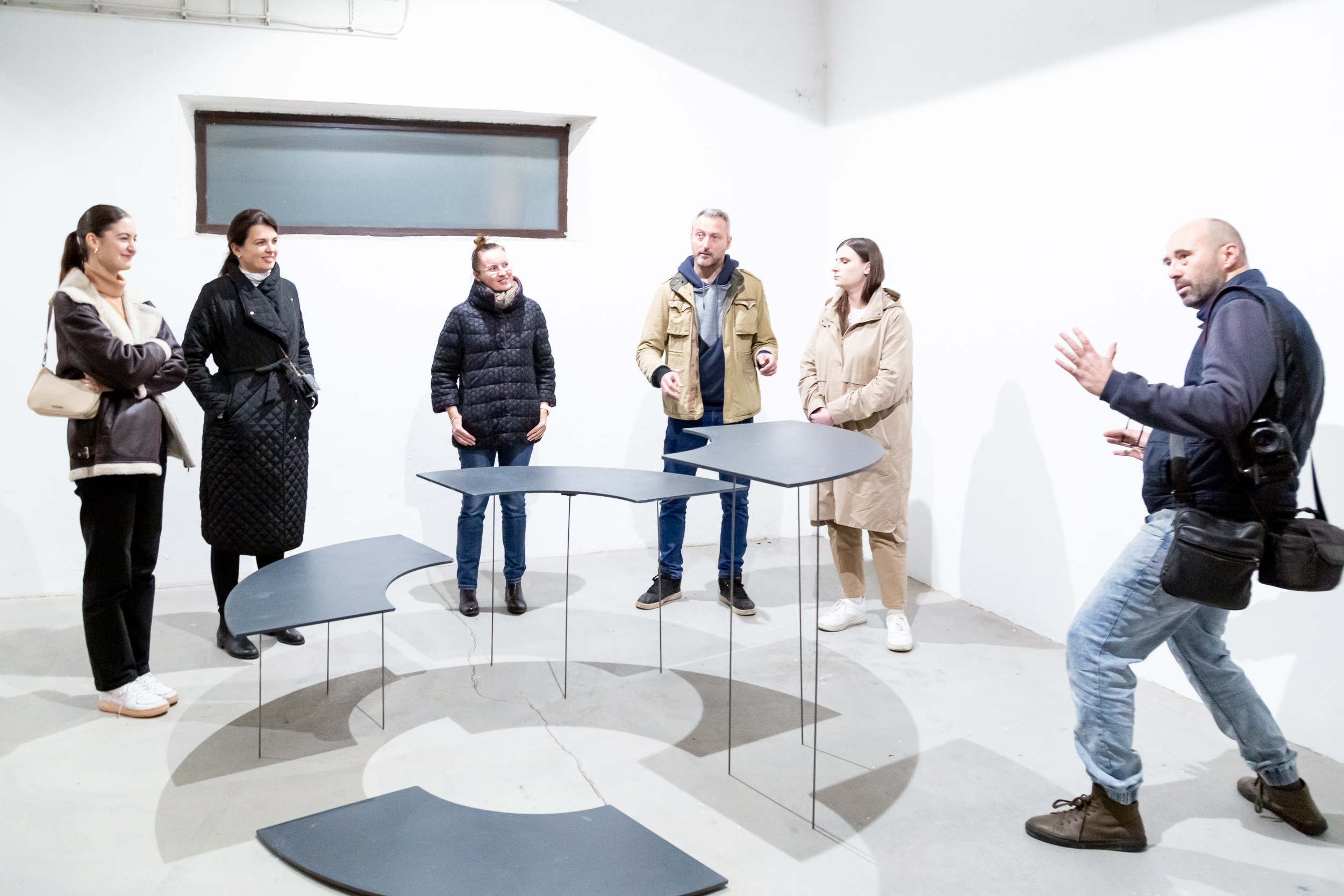
The joint work of the duo entitled Fragile Truce is an object—a round table divided into four symmetrical parts. The segments are positioned at different heights, with one even placed on the ground. Each part represents a space for countries negotiating peace. However, the imaginary peace table stands on thin, unstable legs—symbolically as well as literally and materially. In this shared intervention, Dudas Brothers express the persistent inequality between negotiating parties who occupy different positions of influence and power. Not only the negotiating table is unstable, but also the possible outcomes of negotiations and agreements. This ambivalent work was originally accompanied by a performance in which the masked artists stood opposite each other, engaging—or failing to engage—in a wordless dialogue. In doing so, they expressed the status quo and the impossibility of dialogue as such, perhaps precisely because anonymity and mass identity allow personal responsibility to be concealed. The performance Fragile Truce is also part of the exhibition at FOR MAAT; however, the artists no longer appear anonymously or masked, but instead present themselves openly, acknowledging their individual identities. They also invite the audience to participate in the performance/happening, to approach the negotiating table and attempt to initiate dialogue themselves.
At the exhibition RE:PLAY, Ivan Dudáš presents several works addressing current local issues. One example is the rise of the new Minister of Culture, whom he asks to resign in a video letter due to her incompetence and earlier statements regarding migrants. The letter is accompanied by a projection depicting migrants sleeping at a train station, ignored by anonymous passers-by. Another work also relates to the minister’s statements and the overall orientation of the government, which promotes cultural separation and emphasizes national pride and patriotism. Ivan Dudáš responds to these statements through play and irony by creating stickers of Slovak historical figures as well as contemporary personalities and anti-personalities from Slovak culture and politics—a reference to the claim that “we do not want to label ourselves” (as stated by the minister). These stickers are also offered to viewers, who may freely choose them and place them directly within the exhibition space or elsewhere. The theme of play and its strategies in visual art, combined with so-called high and low forms and principles, is most evident in another work that oscillates between the entertainment of computer games and artistic reflection on contemporary issues—specifically the digital and media space filled with conspiracies, post-truths, fake news, and hoaxes.
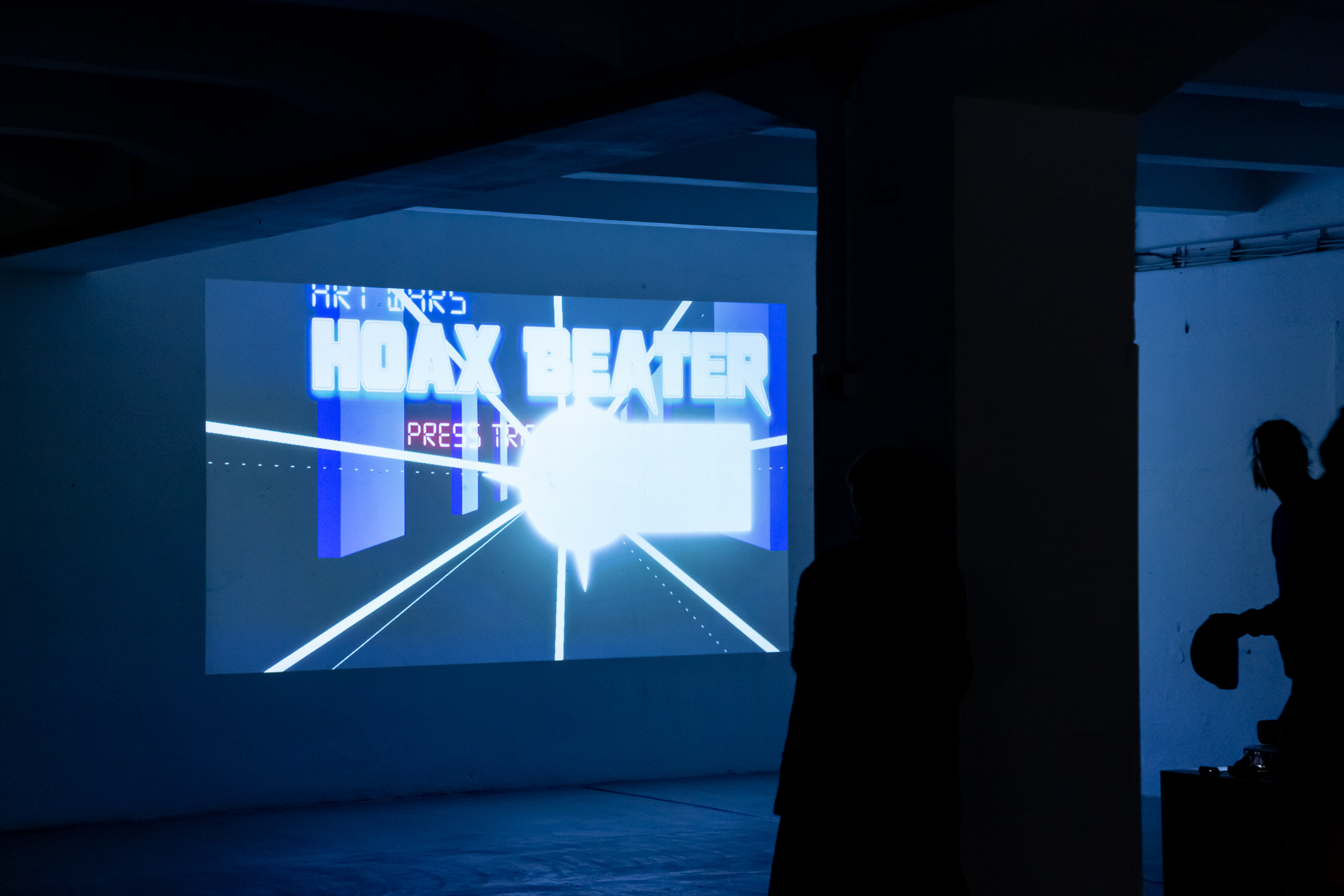
The VR installation by Ivan Dudáš titled Hoax Beater was originally created under the name ArtWars: Hoax Beater for the DOM 2019 AutoCorrect festival at Nová Cvernovka, which focused on correctness at the intersection of online and offline worlds and interpersonal relationships. The work was created in collaboration with Michal Kabát and Dalibor Bartoš and has been adapted to the current context of the rise of the new Slovak government. Hoax Beater (2019/2023) is an interactive work situated between a visual artwork and a computer game. In the era of hybrid information warfare, it offers a playful opportunity to defend against and combat disinformation and hoaxes. Viewers can symbolically become part of a virtual space where freedom and truth can prevail. The VR installation operates through software in which the viewer decides, within the game environment, what constitutes a hoax or disinformation, or who is spreading it. They can then destroy the false information or persona with light sabers and earn points. The VR intentionally adopts the visual language of simple computer entertainment to reach a broader audience and demonstrate that art can also be a game—with a reference to the possibility of effecting change.
The artistic activism of Dudas Brothers is distinctive and, as it turns out, still relevant and necessary. Within the Slovak art scene, Dudas Brothers are a phenomenon not only because they form a sibling artistic duo. The alternative space FOR MAAT in Trenčín has provided them with generous spatial opportunities within the exhibition RE:PLAY, allowing for the preservation and renewal of the continuity of their joint projects—continuity that will hopefully persist into the future.
Ivan Dudáš (1980, Trnava) is a graduate of the master’s program at the Department of Painting and Other Media at the Academy of Fine Arts and Design in Bratislava, as well as doctoral studies at the Faculty of Fine Arts of the Academy of Arts in Banská Bystrica, in the Intermedia Studio led by Assoc. Prof. Miroslav Nicz. He is an intermedia artist and educator. He works with found film, image, and sound (so-called found footage), focusing on their deconstruction, interactive extensions, and possibilities for audience participation. Many of his projects fall within political and social activism. He has long collaborated with his brother Juraj as part of the Dudas Brothers tandem.
Juraj Dudáš (1975, Trnava) is a graduate of the Open Studio of Prof. Rudo Sikora at the Academy of Fine Arts and Design in Bratislava and the Intermedia Studio of Prof. Milan Knížák at the Academy of Fine Arts in Prague. He is a multimedia artist and educator and has also occasionally worked as an exhibition curator in the past. His works are post-conceptual in nature and revolve around interpretations of texts, slogans, and words that are transformed into installations, objects, and performances. On a conceptual level, his work draws on current socio-political issues and conflicts, which he addresses either individually or within the collective identity of Dudas Brothers.