Affordances - curator's text
Author Kristína Seidlová
Curator Veronika MArek Markovičová
Author Kristína Seidlová has been reflecting on architecture through the medium of photography for several years. During this time, she has developed the projects Transitional States (2019), Forgotten Memory (2023), and To Educate and Instruct. Is It Possible to Use Architectural Space Democratically? (2024). In this exhibition, she presents these projects together not only to highlight the diversity of photographic approaches to architectural thinking, but also to reveal their points of intersection and the development of her authorial language.
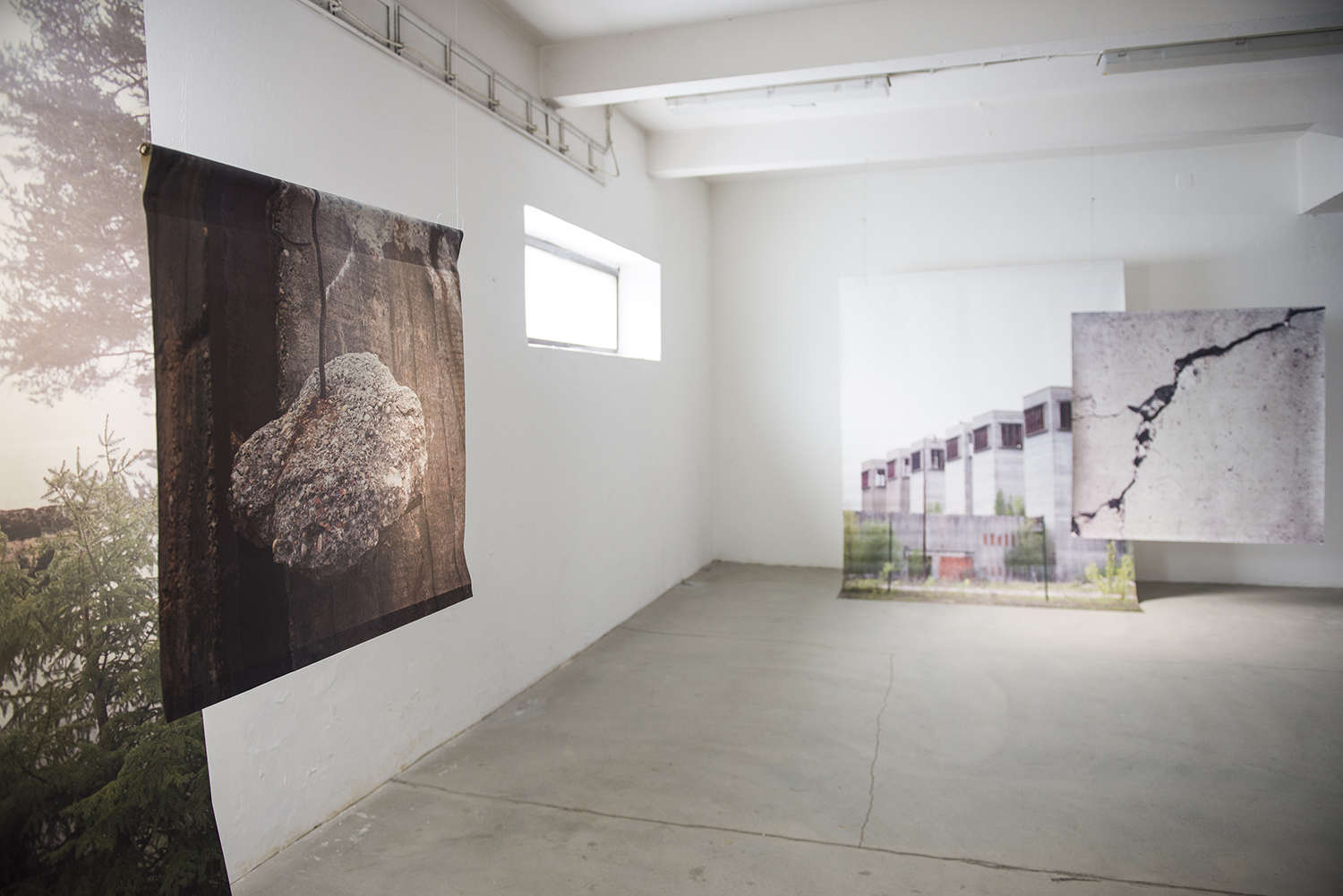
In Transitional States (2019), Seidlová maps decaying industrial buildings. Photographs of concrete torsos are presented as disintegrating monuments to abandoned ambitions, left without purpose in the landscape. Their loss of meaning contrasts with a factual mode of depiction, large-format prints, and a video loop of endlessly flowing concrete that eventually hardens—regardless of whether our decisions, transformed into buildings, are sustainable in the long term or not.
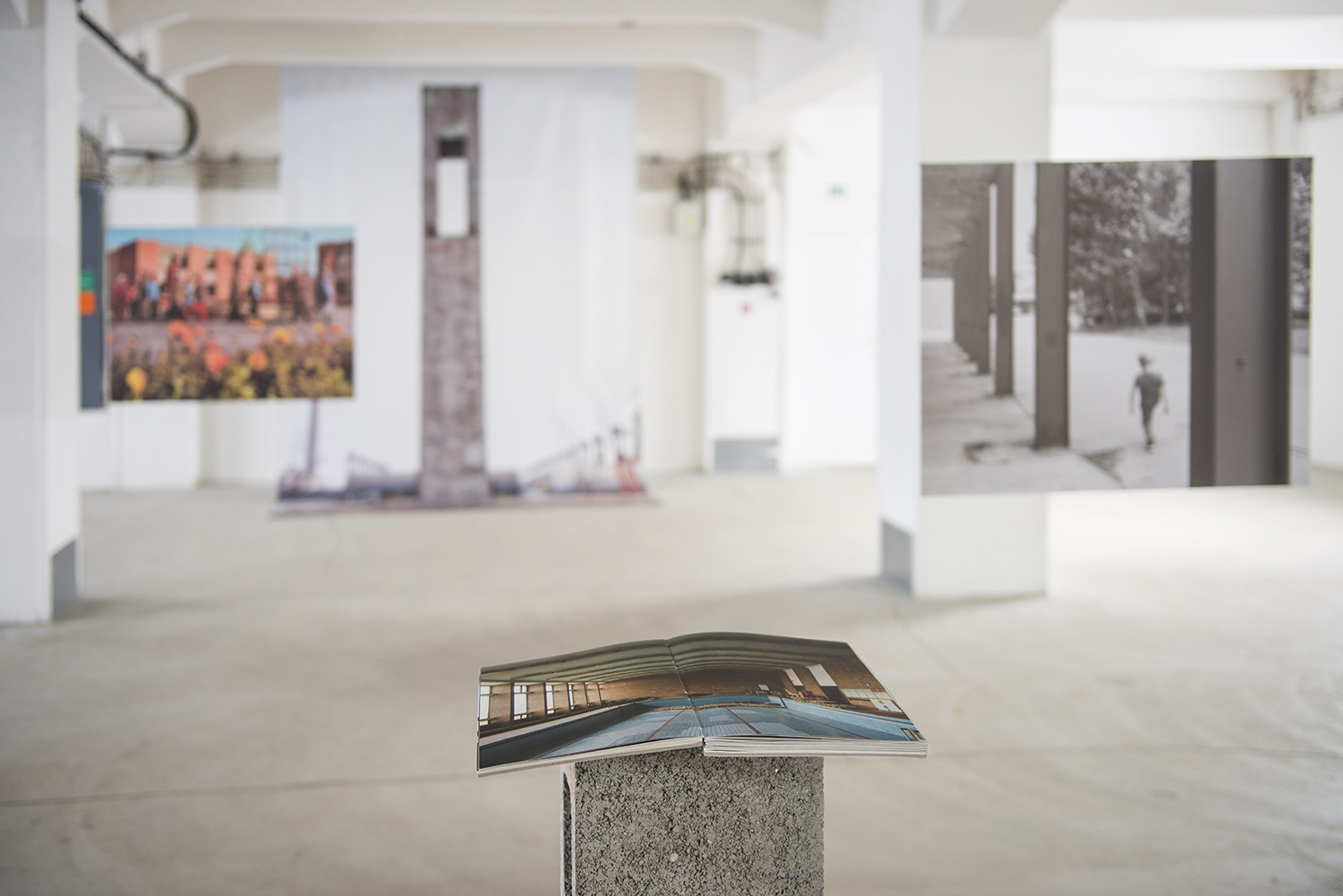
While Transitional States observes a process of final degradation, the project Forgotten Memory (2023) offers a comprehensive examination of the Children’s Town in Zlatovce on the outskirts of Trenčín—a pioneering project by architect Peter Brtko from the mid-1960s. Between 1974 and 2005, it functioned as a unique family-type children’s home, while also providing space for everyday life and education. Through a combination of archival materials and her own photographic research, portraits of former residents, and an interview with therapeutic pedagogue, educator, and psychotherapist Albín Škoviera, the artist reconstructs the project’s original intent, its realization, fulfillment, and gradual degradation. She evokes the memory of the place through its witnesses, while also allowing the space itself to speak in its current state, revealing layers of long-term use and accumulated memories.
The third part of the exhibition is the project To Educate and Instruct. Is It Possible to Use Architectural Space Democratically? (2024). Here, the artist enters school buildings constructed during the educational reform period in Slovakia in the 1960s to explore whether these once-progressive structures still function today and fulfill their educational role, and how they cope with spaces defined in the past but used in the present. Within the dichotomies between public and personal space, individual identity and mechanisms of education, and between materiality and the articulation of architectural space that shapes our movement within it, she moves from documenting space toward photographic simulation of how space is perceived and experienced. By analyzing both her own perception and the natural behavior of her child within these environments, she translates her findings into a wide spectrum of visual forms—sequential horizontal and vertical bands suggesting forward or lateral movement, shifts in scale, aerial perspectives captured by drone, and the overall installation strategy. Through these means, she formulates responses to her guiding questions: “To what extent does space allow me to make free and conscious decisions within it? How well can I read it and behave accordingly? Is space open in itself, and open to our own decision-making?” Moving beyond the aestheticized documentation of buildings, she deliberately reduces her visual language to black-and-white images and short video recordings of walking, allowing the mass and architectural solutions of school interiors and exteriors to emerge more clearly. In doing so, she visualizes affordances (James Gibson, Don Norman)—the perceived or actual properties of objects that determine possibilities for action within a given environment, independently of an individual’s ability to perceive them.
Several perspectives converge in Seidlová’s authorial position: that of a photographer; a university-educated woman who has spent eighteen years of her life in various types of schools; a mother of a child currently attending kindergarten; and a secondary school teacher. This spectrum of viewpoints opens a broad circle of questions and facts with ambiguous answers: How can approaches to education and upbringing change in a country that does not build new schools reflecting new pedagogical models? It may even seem that education and deteriorating school buildings are intentionally kept on the margins of public interest, so that critically and independently thinking individuals do not become inconvenient. Yet, rather than directing criticism solely toward politicians, we should also look into our own nests—the vast majority of parents perceive school as a place to store their children while they work, and are often unable to articulate their demands for systemic change, if they have reflected on them at all. And what about the children themselves? Is it enough for them to be “lucky” enough to have educated parents, a few excellent teachers, and good friends? What is the key moment at which we can say that we are free and conscious actors, and that we raise our children in the same way? Is it enough to live in accordance with our values and to be able to meet our own needs?
Kristína Seidlová (1996) is a graduate of the Department of Photography and New Media at the Academy of Fine Arts and Design in Bratislava (2024). She currently focuses on architectural and urban photography. Her recent projects explore the memory of place and the impact of architecture, education, and upbringing on the individual. She often complements spaces with photographic portraiture or the human figure. Thematically, she reaches into history and confronts it with the present. In 2024, she received an honorable mention for the book Forgotten Memory at the Faculty of Art of the University of Ostrava. For her most recent work, Boundaries of Inclusion, she was awarded the City of Bratislava Grant within the Slovak Press Photo Foundation (2024). She currently also works as a teacher at the Secondary School of Applied Arts in Trenčín.