Enchanted Bratislava – curatorial text
Author: Filip Bielek
Curator : Miroslava Urbanová
You can explore a photo report from the exhibition here.
The inaccessibility of housing is increasingly entering the focus of broader societal discourse—yet it still appears mainly as a topic of media debate analysing the causes of this situation, or as more or less empty promises within pre-election struggles over rental housing. However, it is not only a question of who possesses purchasing power (or rather investment purchasing power), or how many low-income individuals must squeeze into overpriced rentals. What should concern us just as much is what is being built, how and for whom, what kind of environment this construction intervenes in with its mass, and how it co-creates that environment.
Filip Bielek observes the transformations of the city of Bratislava and thematises them in his socially critical projects through ironic exaggeration. One could say that one of the main villains here becomes the developer—the capitalist who builds new downtowns and creates districts primarily for a clientele able to pay for “above-standard” living. He does not negotiate his sandbox. At the same time, Bielek reflects more broadly on what has happened to the quality of architecture after the fall of communism, identifies hotspots of debate around public space, and observes the ways in which this space is being transformed.
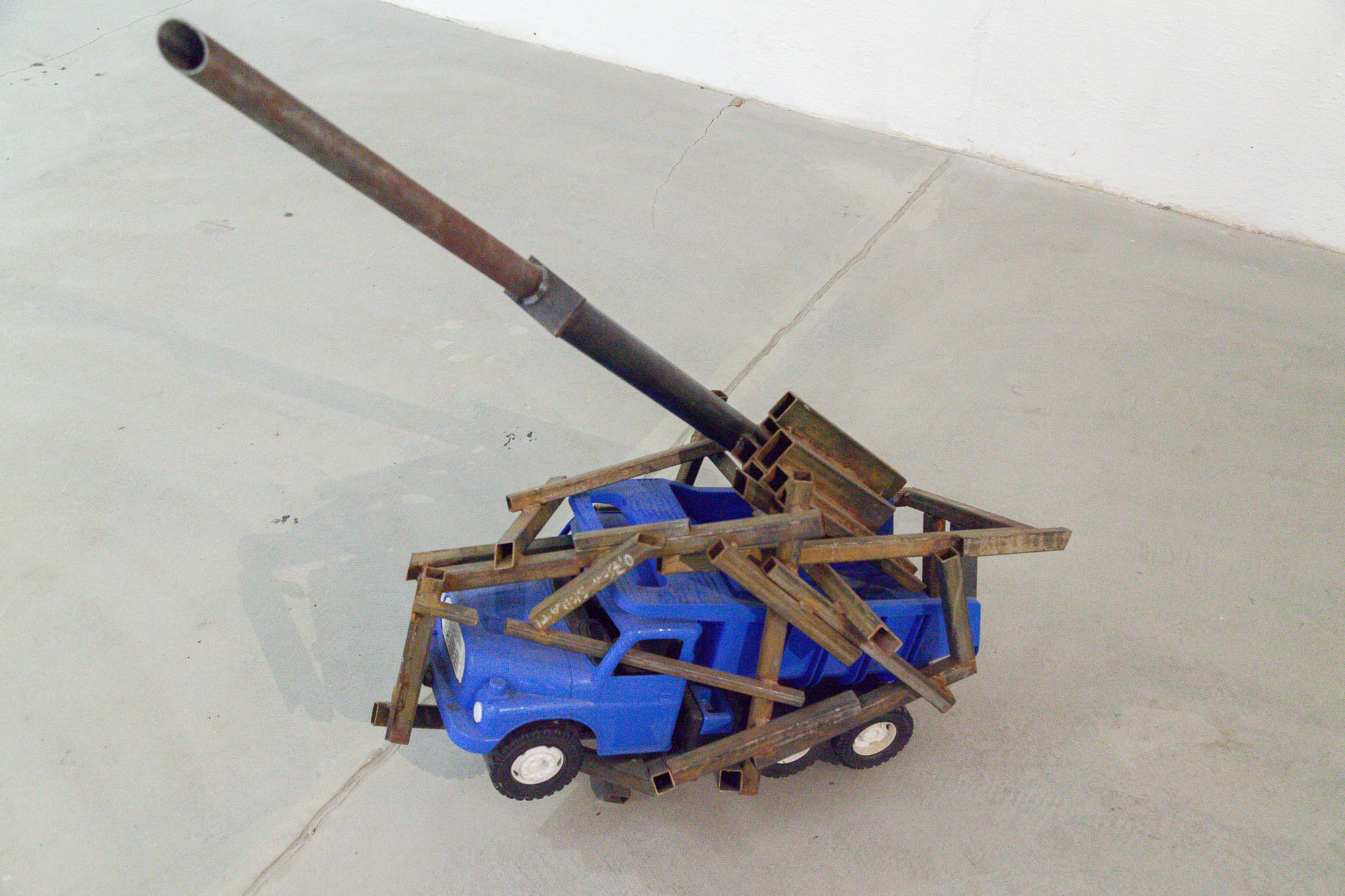
In addition to free-standing sculpture, planar and spatial objects, drawings, and provocative comments on laminated A4 sheets, Bielek is the author of a monumental intervention on an existing post office building in Petržalka; the compiler of a pocket guide to Petržalka architecture after 1989; an amateur archivist of screenshots from articles related to the controversy surrounding the renovation of the Danube Hotel façade; and an impassioned participant in discussions on public space.
In his practice, Bielek deliberately works with the aesthetics of graphic-design kitsch and recognisably cheap materials such as insulation polystyrene and plastic. He handles their combinations just as freely—or carelessly—placing emphasis on conceptual coherence and on exposing discrepancies in competences and rhetoric, not only on the part of investors but also public authorities in the creation of and interventions in public space. The extraction of materials from their original contexts produces new, audaciously therapeutic combinations. Their staging in space becomes an authorial play with scale, materials, and forms, a deconstruction and exposure of the absent value foundations underlying the blind accumulation of capital.
This time in Trenčín, Bielek presents his Bratislava-based projects through a gesture of subversive translocation, which nevertheless remains part of a shared Slovak visual and social non-culture. He disseminates primarily images of post-communist architecture and the shaping of public space which, to date, have produced in the capital city only a minimal number of non-commercial spaces, affordable housing options, or cultural venues. Beautiful publications about urban development may be produced, yet the city’s growth should not come at the expense of zones that are vital to the overall ecosystem and its significant habitats.
These zones have no way of shaking hands with the invisible hand of the market, which is rarely helpful—especially in places where competition is meaningless, and where quality is based on cycles longer than several human lifetimes. If we are to disengage from an approach focused primarily on profit, where grand promises remain trapped in high-end visualisations while we inhale exhaust fumes underground in the so-called bus station waiting for environmentally conscious public transport, we need to set the rules differently than we have so far.
Bielek observes the creation of the living environment in Bratislava across decades, beginning with mass housing construction under socialism, as well as the ideological colouring of rhetorics and ornaments that convey preferred narratives. He is interested in materials that determine appearance, functionality, and also the value systems embedded in approaches to architecture.
Above all, he is incensed by interventions driven by the libidinal force of capital accumulation aiming at unlimited growth at the expense of the surrounding environment. His Enchanted Bratislava is not a fairy tale, but an expression of long-term frustration and a civic as well as authorial engagement with a topic that profoundly shapes our everyday perception of the world around us.
Filip Bielek was born in Bratislava. In 2010, he graduated from the Josef Vydra School of Applied Arts in Bratislava, Department of Stone Sculpture, under academic sculptor Vojtech Pohanka. He subsequently continued his studies at the Academy of Fine Arts and Design in Bratislava, at the Department of Sculpture, Object, Installation, in the studio Sculpture in Architecture and Public Space led by Assoc. Prof. MgA. Patrik Kovačovský. In 2014–2015, he completed a study residency at UAP Poznań (PL) in the studio of Marcin Berdyszak.