Landscape frottage – curatorial text
Curator: Ema Čabová
You can view the photo report from the exhibition here
Juraj Hubinský is an artist whose practice spans multiple positions and approaches. The exhibition Landscape Frottage presents one of these perspectives and shows us what happens when an architect begins to paint. By constantly crossing the boundary between architecture and painting, Juraj gains something that often begins to slip away after long immersion in a single medium: on the one hand, distance, and on the other, an authentic curiosity and engagement with what one medium can carry — and what is better transported to the other side.
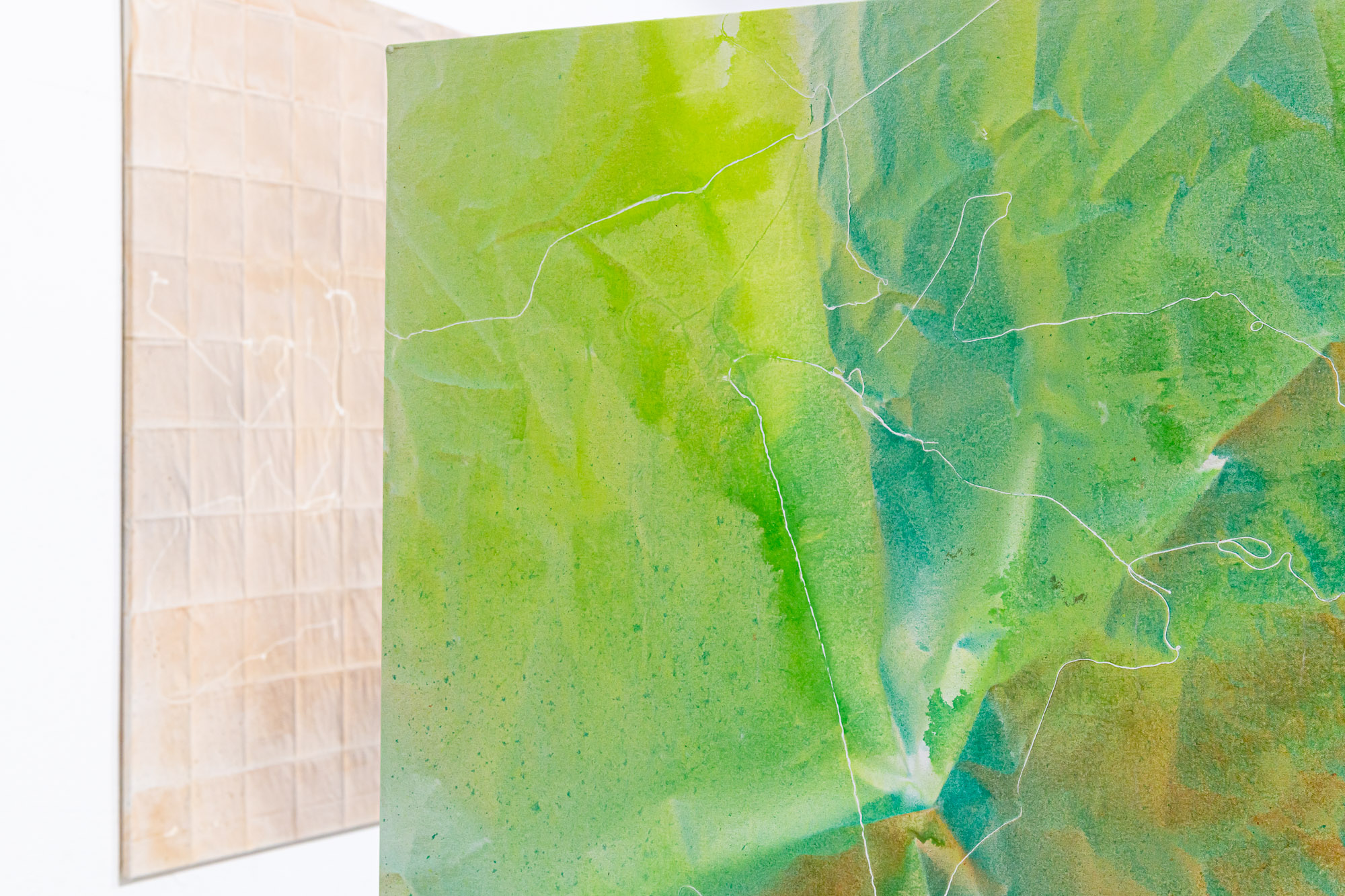
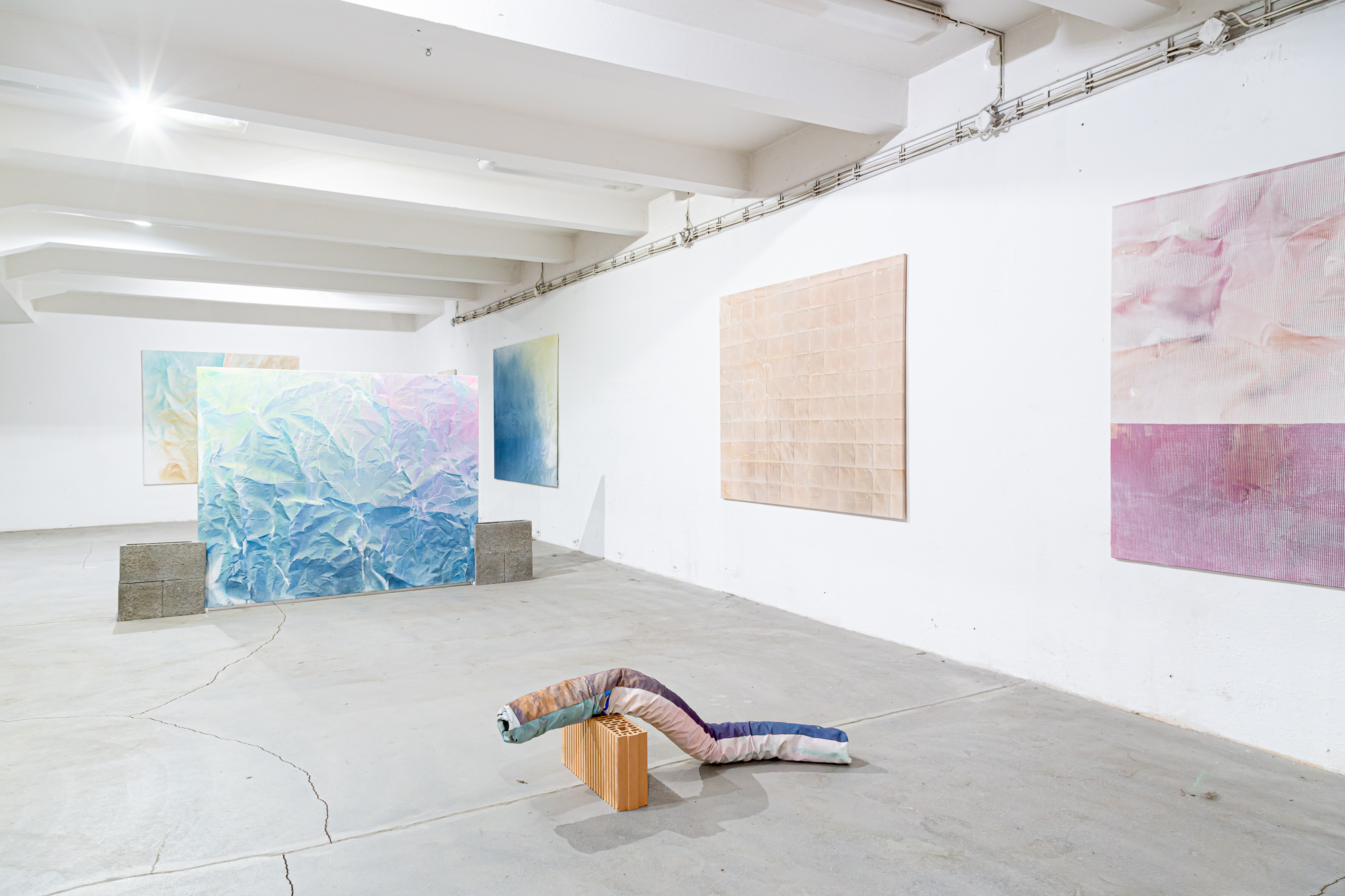
The title Landscape Frottage refers to a series of paintings and objects in which an honest fascination with the medium and painterly processes mixes with dirt, architectural waste, and elements hidden deep within the bodies of buildings. At the same time, it is truly a “landscape frottage,” because the paintings emerge through exploring landscapes and transferring small fragments of architecture onto canvas. They become records of various dynamics that gave these works life — from movement between media, the gathering of material itself, to the very process of their creation.
Through his painterly approach, Juraj “de-bones” architecture: he carefully selects certain elements and then carries them into the medium of painting. These seemingly banal architectural components are aestheticized and cast into leading roles within his works. Corrugated metal sheets, reinforcement meshes, wire fences, construction nets, plaster grids, and other elements we either do not notice or stumble over while passing building sites suddenly become bearers of painterly content. They too, together with Juraj, migrate from one medium into another.
Moreover, through a certain sincerity and “purity” of vision, the artist — more or less intentionally — gently undermines painting itself and tests its rules. He uses it as a framework and explores what it allows. His objects of interest are not typically painterly, and in fact, he does not really paint them. Their life on canvas is given through the airbrush.
A tool usually associated with achieving perfect, uniform surfaces — one that anonymizes the brushstroke fetishized by painting — is here used by Juraj to render imperfection. Yet it is precisely the airbrush that gives his paintings their distinctive aesthetic and, paradoxically, also an unmistakable authorial signature.
The result of this process — partly pragmatic, partly conceptually driven — is a symbiotic communication between architecture and painting, an exchange in which what is secondary for one becomes a treasure for the other. What architecture does not permit, painting allows, and vice versa. Juraj mediates this dialogue with sensitivity.
Juraj Hubinský (1986, Trenčín) completed his MA studies at the Academy of Fine Arts and Design in Bratislava in the Department of Painting and Other Media, Studio +- XXI under Daniel Fisher in 2017, and graduated from the Faculty of Architecture at the Slovak University of Technology in 2011. For his architectural work, he was nominated for the CEZAAR Award in 2020 and 2021.
Ema Čabová (*1997, Bratislava) is a curator and theorist of contemporary art. She earned her BA in Art History at the Faculty of Arts, Comenius University, and her MA in Theory and Practice of Contemporary Art at the Academy of Fine Arts and Design in Bratislava. She previously worked at Krokus Gallery (2017–2019) and Zahorian & Van Espen Gallery (2019–2021). Between 2019 and 2023, she was a member of the APART collective, focusing on curatorial, research, publishing activities, and project management.
In 2020, she co-founded the gallery A Promise of Kneropy in Bratislava, where she served as art director and curator. From 2021 to 2023, she worked at tranzit.cz in Prague. Her texts have been published in FlashArt CZ/SK, Artalk.cz, and Fotograf Magazine. Since 2022, she has been a member of the editorial board of FlashArt CZ/SK. In 2022–2023, she was the curator of the Oskár Čepan Award 2022.