Pilgrimage attraction – curatorial text
Athors: Pali Hovanec, Peter Barényi
Text: Lucia Kotvanová
You can find the photo report from the exhibition here.
The exhibition Pilgrimage Attraction is not merely a title or a metaphor framing the works of both artists. It is an authentic and unique project created specifically for this space and moment—a literal attraction.
The concept of pilgrimage naturally carries a dual, historically layered meaning. On the one hand, it refers to a religious tradition—a journey toward a sacred site that has accompanied humanity throughout history. On the other, in everyday language it is associated with fairground attractions, a travelling visual spectacle of carousels and lights. Over the centuries, what was once a spiritual intention often turns into an empty show, a superficial façade.
Barényi and Hovanec transform this contradiction into a creative principle. Pilgrimage becomes a metaphor for their own artistic process—a journey that has shaped them and is inscribed in their work. Their “pilgrimage attraction” thus becomes an image of a shared reality.
The exhibition architecture unfolds as a site-specific work reminiscent of an improvised cathedral. The gallery space is arranged to guide the viewer along a central “nave,” beneath a cross vault, toward a dominantly illuminated altar displaying fragments of the artists’ previous works. In this setting, the artworks enter new relationships and constellations—irony intertwines with sincerity, and the light-based language of fairground effects merges with the tradition of sacred icons.
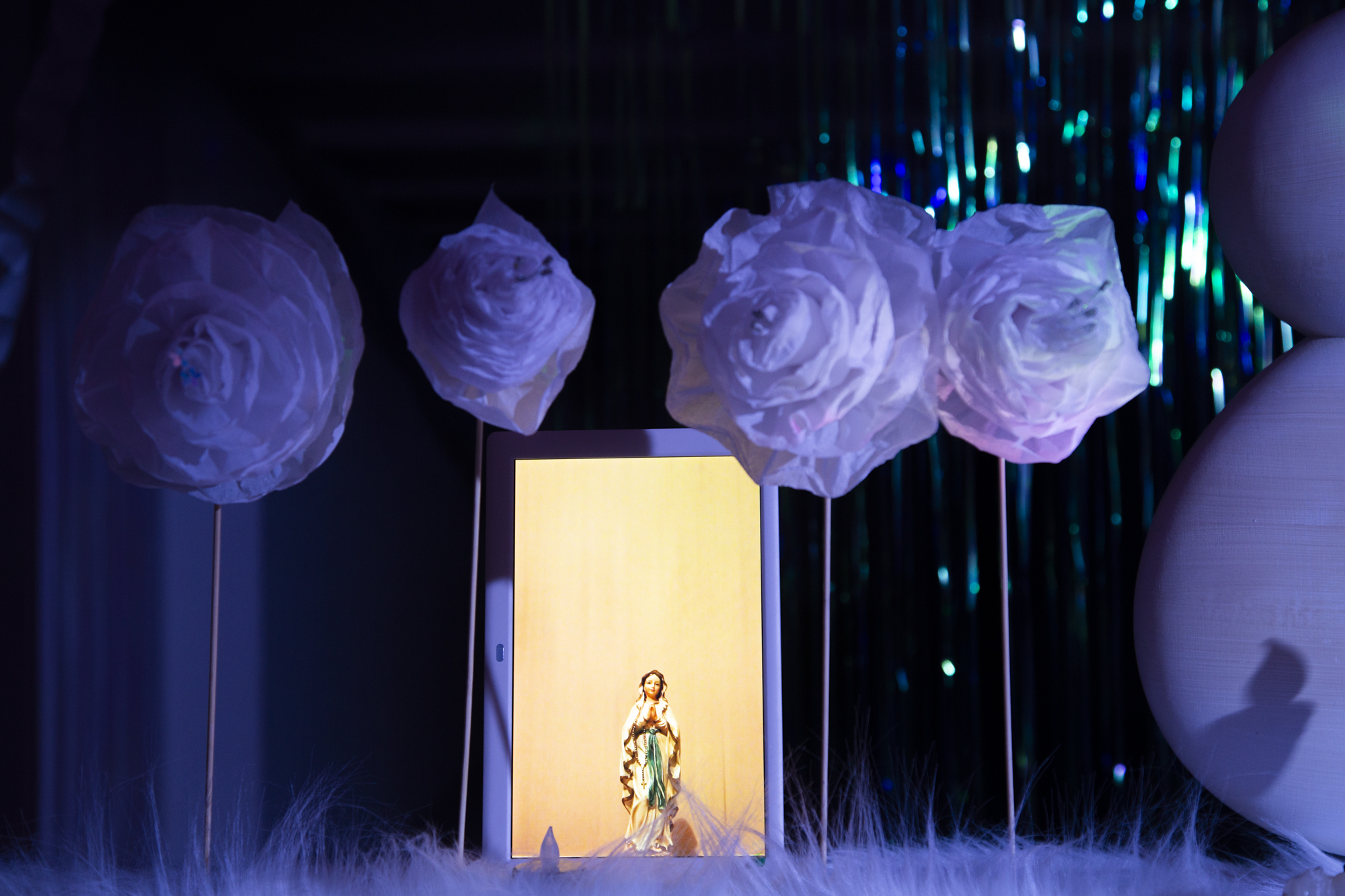
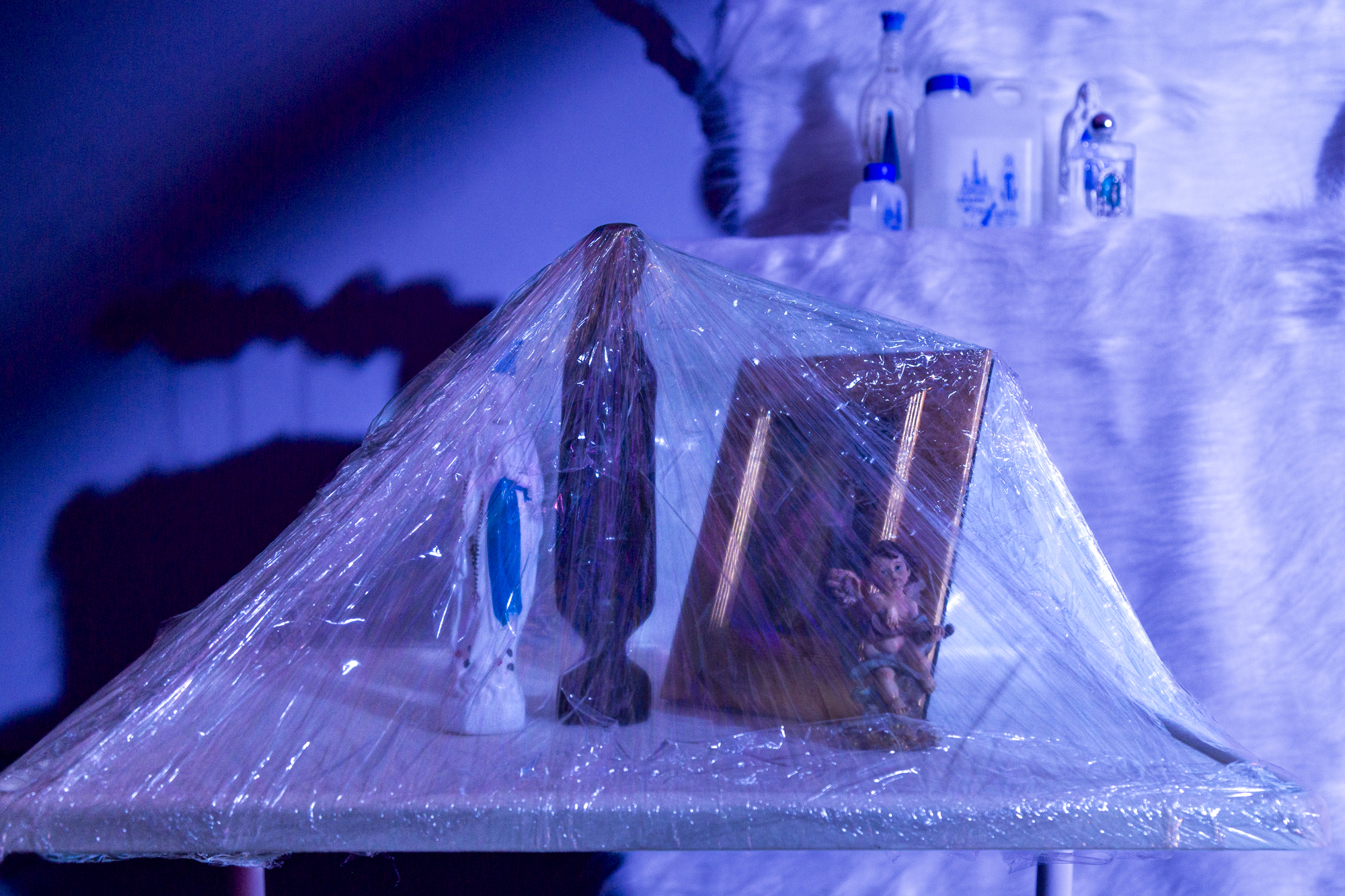
The central element is an altarpiece by Peter Barényi from the series Exactly What Your Living Room Is Missing. A photograph of a readymade figurine of the infant Jesus, whose specifically broken fingers form an obscene gesture, is set within an opulent, “bloated” frame. In dialogue with it stands a video installation by Pali Hovanec—a Virgin Mary ascending in a slow, comical “elevator-like” Assumption. Hovanec has long worked with collections of religious objects, relics, and cheap souvenirs, transforming them into luminous, ironizing scenes. The aesthetics of a “party space” and sacred kitsch intertwine in his work with personal fascination. A distinct incorporated element that stands apart in content is a table wrapped in plastic film, preserving it. This table with religious objects is a readymade belonging to Barényi’s mother; she kept it by her hospital bed in her final moments.
The atmosphere of the exhibition is further shaped by the sound of a music box playing Schubert’s Ave Maria, creating a subtle, even disturbing counterpoint to the visual exaggeration. Additional elements—artificial flowers, shooting-gallery roses, crepe paper garlands, and white plush—appear throughout the space, forming part of a new whole. The altar transforms into a shooting gallery, the cathedral into a fairground.
The common denominator of both artists’ works is an aesthetic of “glitter”—the visual language of cheap attraction that nevertheless carries critical content. Their work is rooted in reality and authentic experience. Although they employ religious motifs, they do not adopt their spiritual dimension. Instead, they are fascinated by the external façade—overexposed, unrealistic, often impractical, and kitschy. Their practice moves along the edge of ironic reflection: the world they create is both ridiculous and touching, cheap yet precise.
Pilgrimage Attraction is therefore not merely a presentation of artworks, but opens a space for humor, critique, and self-irony. It is a pilgrimage—of each of us, yet different for everyone. Rather than offering a spiritual meditation, the exhibition presents a reflection on the mechanisms of visual culture: how symbols are emptied of meaning and transformed into decoration.